Calculate car loan repayments with our Car Loan Repayment Calculator. View detailed amortization charts to compare terms, track interest, and plan your budget with confidence.
Calculator results are estimates only and not quotes. Actual quotes will be provided by licensed brokers after you submit an enquiry.
Car Loan Details:
Important!
Car Loan Interest Rates differ from lender to lender and will depend on your individual circumstances (credit history, employment status, age, etc.). To find out if you qualify ... and for a free, personalised interest rate and repayment quote,
please CLICK HERE
Car Loan Amortisation Calculator
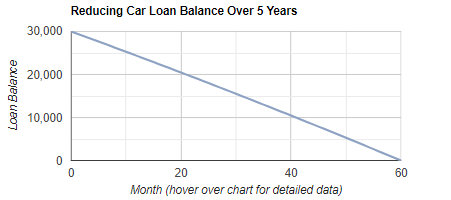
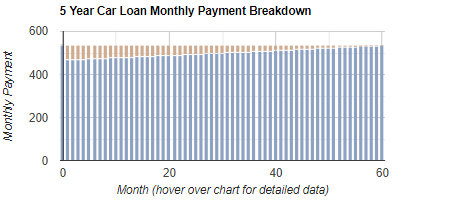
The following amortisation graphs detail month-by-month data on the progress of the proposed loan. The first chart below examines the reducing loan balance over the course of the finance contract term. The second graph illustrates the portion of each monthly repayment allocated to payment of interest vs principal reduction.
How to use our Car Loan Repayment Calculator
Our Car Loan Repayment Calculator helps you estimate repayments for an Australian car loan and see how your balance, interest and principal change over time. It is important because small changes to the loan amount, term or interest rate can materially affect your monthly budget and the total interest you pay. The amortisation charts make it easier to compare scenarios and choose a structure you can afford with confidence.
General information only: This calculator provides an estimate and does not take into account your objectives, financial situation or needs. Results are indicative and your actual interest rate and repayments will depend on the lender, your credit profile and the final loan contract (including fees and conditions).
How to complete each section for the best result:
1. Purchase Price
Enter the vehicle purchase price as a whole number (no decimals or commas). If you plan to borrow extra for on-road costs such as stamp duty, registration or insurance, include those amounts here so the estimate better reflects your likely loan size.
2. Deposit or Trade-in Value
Enter your cash deposit and/or trade-in value as a whole number. A higher deposit reduces the amount financed and usually lowers repayments and total interest.
3. Term of Loan (Years)
Select the number of years you want to repay the loan over. Shorter terms usually mean higher repayments but lower total interest. Longer terms can reduce monthly repayments but typically increase total interest paid.
4. Interest Rate (% per annum)
Select an interest rate to simulate. If you have a quote, choose the closest rate. If comparing options, run multiple calculations to see the impact of different rates.
5. Calculate
Click calculate to generate your results and charts.
How to interpret the results:
1. Repayment estimate: Use this as a starting point for affordability, leaving buffer for running costs and rate changes.
2. Amortisation charts: One chart shows the loan balance reducing over time; the other shows how early repayments are often interest-heavy and gradually shift toward principal repayment.
3. Comparison planning: Re-run the calculator with different terms, deposits and rates to identify a repayment level and total interest outcome that suits your budget.
When it comes to financing a car, the importance of vigilance cannot be overstated. Navigating through the maze of loan offers and financial jargon can be overwhelming, making it all too easy to overlook critical details that could cost you dearly in the long run. - read more
Finding the right car is only one part of the buying process. The loan you choose can affect your repayments, flexibility and total borrowing cost for years. This guide explains how to prepare for car loan negotiations, compare offers, discuss rates and fees, review the agreement before signing, and manage the loan after settlement. - read more
Australian car loan borrowers have protections around licensing, disclosure, responsible lending, hardship assistance, repossession and complaints. This guide explains the key rights to understand before applying for or managing car finance. - read more
When it comes to purchasing a car, one of the biggest decisions to make is choosing between a long-term and short-term car loan. Understanding car loans and their significance can make a substantial difference in your financial future. - read more
Personal car loans and business car loans can both help Australians finance a vehicle, but they are assessed and structured differently. This guide explains how loan purpose, borrower type, vehicle use, documentation and tax considerations can affect the option you choose. - read more
Your credit score is one of the factors lenders use when assessing car finance. Understanding how it works can help you prepare, compare options more clearly and avoid focusing only on the monthly repayment. - read more
Building a strong credit profile is crucial when it comes to securing car financing. In today's financial landscape, your credit score can significantly impact the kind of loan offers you receive, making it more important than ever to maintain a healthy credit report. - read more
Australian car buyers have received a little more certainty, with the Reserve Bank of Australia keeping the official cash rate steady at its latest board meeting. For households, sole traders and small business owners considering a vehicle purchase, the decision reduces one source of short-term uncertainty. It does not, however, mean car finance has suddenly become simple or uniformly cheaper. - read more
Late-August car loan market reporting suggests Australian borrowers are still seeing pockets of sharp competition, particularly for newer vehicles and applicants with strong credit profiles. That is encouraging for households and small business owners who delayed a purchase during the winter, but it should not be read as a blanket sign that all finance has become cheaper or easier to secure. - read more
Australia’s electric vehicle story is moving beyond new-car sales and into the used-car yard. Latest industry reporting points to a softer second-hand EV market, with prices under pressure as more near-new electric cars reach resale channels and manufacturers keep discounting selected new models. For buyers, that can look like an opening: a lower purchase price may bring an EV within reach without stretching to a brand-new model. - read more
Australia’s New Vehicle Efficiency Standard has moved from policy debate into a practical market force for new-car buyers. The scheme is designed to push the national fleet towards lower-emission vehicles by setting targets for car makers across the vehicles they supply. It does not ban petrol or diesel models, but it does change the commercial pressure behind what arrives in showrooms, how it is priced and where incentives may appear. - read more
Australia’s new-car market has entered a very different phase, with June 2026 delivering the strongest monthly sales result on record and electric vehicles moving from niche consideration to mainstream choice. The latest figures show more than 140,000 new vehicles delivered across the month, with battery-electric models accounting for almost one in four sales. For car buyers, that is not just an automotive story. It is a finance story. - read more
Fresh July 2026 car loan comparison data points to a competitive market for well-qualified borrowers, with some secured car loan products advertising rates in the mid-five per cent range. For buyers looking at a new or near-new vehicle, that may sound encouraging after a period of higher household costs and tighter lending conditions. But the more useful takeaway is not simply that lower advertised rates exist. - read more
Australia’s new-car market has delivered another major signal to borrowers: the vehicle choices shaping car finance are changing quickly. In June 2026, combined new-vehicle deliveries reached 140,058, making it the strongest month recorded for the local market. The headline number matters, but the detail matters even more for buyers planning personal or business car loans. - read more